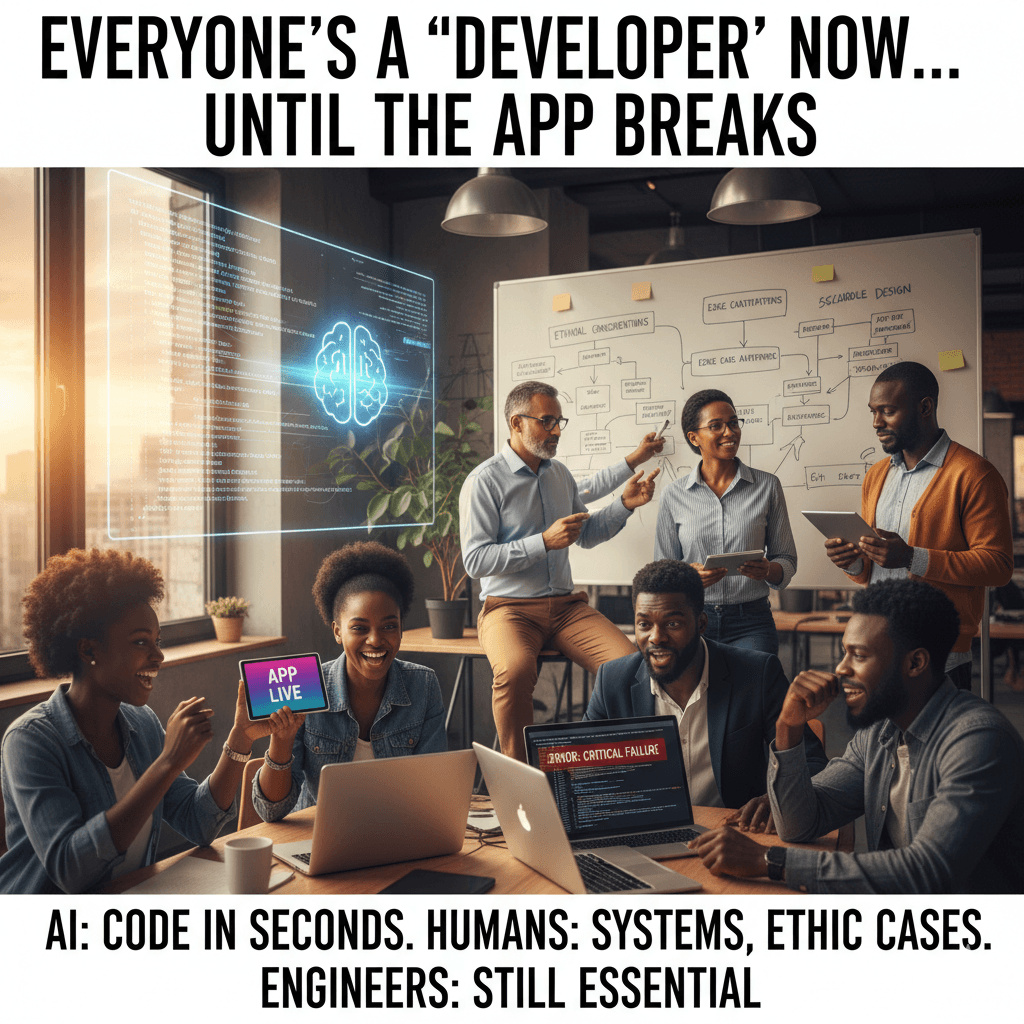
The rise of vibecoding tools is changing software creation, but human engineers remain the architects of logic, ethics, and experience.
The Hype: “Anyone Can Build an App Now”
Vibecoding tools: AI platforms that turn plain-language prompts into working apps are exploding. You describe what you want, and an AI spins up a prototype in minutes. It feels magical. For many non-developers, this is the moment they’ve been waiting for: finally, the barrier between “idea” and “app” seems gone.
And that’s where the myth begins.
We’ve entered an era where prompt engineering feels like programming and where product demos can look deceptively complete. But the illusion that “AI replaces software engineers” is as dangerous as it is exciting.
The Reality: Code Is Only Half the Story
AI can now generate layouts, logic, and APIs with alarming speed. But writing code has never been the hardest part of building great software. The real work lies in design architecture, system reliability, scalability, integration, and long-term maintenance; all of which require human reasoning, trade-offs, and foresight.
Software engineers do more than tell a computer what to do; they define how it should behave when things go wrong. They anticipate edge cases, performance bottlenecks, ethical implications, and user experience flows. These are not just technical tasks, they are human ones, grounded in judgement, empathy, and accountability.
Why AI Still Needs Human Engineers
- Context and Intent:
AI interprets prompts, not goals. It can’t distinguish between a good product and a broken one that “runs”. Engineers bridge the gap between business intent and technical reality. - Architecture and Scale:
Building a demo app is easy. Building one that serves a million users across multiple regions, handles data privacy, and stays performant? That’s engineering. - Security and Reliability:
AI doesn’t “understand” security. It can generate insecure code as confidently as secure code. Human oversight remains critical to prevent vulnerabilities. - Ethics and Accountability:
When AI-generated software fails or discriminates, who takes responsibility? Human engineers remain the ethical backbone of technology. - Maintenance and Evolution:
Software lives beyond launch day. It evolves, adapts, and scales. Engineers ensure systems grow sustainably and remain future-proof.
The Future: Collaboration, Not Replacement
Vibecoding isn’t the end of software engineering, it’s an evolution of it. Just as IDEs, frameworks, and low-code tools once amplified developer productivity, AI will become another layer of abstraction. It will free engineers from repetitive coding and empower them to focus on higher-order design and strategy.
In the best teams, AI won’t write the product, it will co-write it. Human engineers will guide the architecture, review the code, and ensure every line serves a real purpose.
The Bottom Line
AI can now build faster than humans but not smarter.
Vibecoding tools may change how we code, but not why we code.
Software engineers aren’t obsolete; they’re evolving into system thinkers, product philosophers, and AI orchestrators. The craft of building software remains deeply human because good software isn’t just made of code. It’s made of understanding.
Final Thought:
Prompt all you want. But behind every great AI-generated app, there’s still a human mind making sense of the chaos.